
Cheyenne County Projected Release Date
A projected release date is a calculated date, not a promise that release will occur at a set hour. In Cheyenne County, it can mean two different things. For a local or contracted jail case, release timing may depend on bond, a court order, sentence served, time-served credit, a warrant hold, or the contracted jail's processing schedule. For a state-prison case, the date is tied to CDOC sentence computation and parole rules.
Scheduled vs actual release: A scheduled date can change before the person leaves custody. The actual release record is the agency record that shows when custody ended and why.
Pretrial custody is the clearest example. A person held before trial may be released if bond is posted, if the court grants a personal-recognizance bond, if charges are dismissed, if a warrant is quashed, or if another court order directs release. None of those events is the same as a CDOC projected prison release date. Cheyenne County does not operate its own jail, so the actual jail release time must come from the contracted jail after the sheriff or court identifies it.
That split also affects the words used in records. A jail may say released, bonded, transferred, or time served. A court may show bond posted, sentence imposed, mittimus, probation, warrant quashed, or dismissal. CDOC may show parole eligibility, mandatory release, parole, or discharge. The safest Cheyenne County projected release date answer names the system that produced the date and states whether the date is pending, calculated, or final.
| Date type | What it means | Best source |
|---|---|---|
| Bond or court release | Release depends on a court order or bond event. | Cheyenne County court and contracted jail |
| County jail sentence | Release depends on sentence, credits, holds, and jail processing. | Housing jail and court sentence record |
| State prison date | Release depends on CDOC computation, parole eligibility, and earned time. | CDOC offender search and parole records |
| Actual release | The final record showing custody ended. | Releasing agency record |
Find Cheyenne County Release Timing
The right lookup starts with the case type. Cheyenne County arrests begin with the sheriff's office, but jail custody may move to a surrounding county because local jail operations are contracted. If a person was sentenced to state prison, the county jail release may be a transfer to CDOC rather than release to the community. For a named-person custody path, the broader search sequence is on the Cheyenne County released inmates home page.
- Call the Cheyenne County Sheriff's Office or review the court case to identify whether the person was locally processed, housed in a contracted jail, sentenced to CDOC, or transferred to another agency.
- For a local jail date, contact the actual contracted jail and ask for the booking number, release date, release reason, hold status, and whether the date is final or still pending.
- For a court-driven date, review the Cheyenne County court record for bond, mittimus, sentence, time-served credit, probation, warrant, or transfer orders.
- For a CDOC sentence, search the Colorado Department of Corrections offender search by DOCNO when known, or by name and gender.
- Open the matching CDOC record and review state custody status, current facility, parole-board information, and release, parole, or discharge timing when the record shows it.
The CDOC offender search is the matching state-prison source for projected release date research. The image below shows the DOCNO, last name, first name, and gender fields used to start a state lookup.
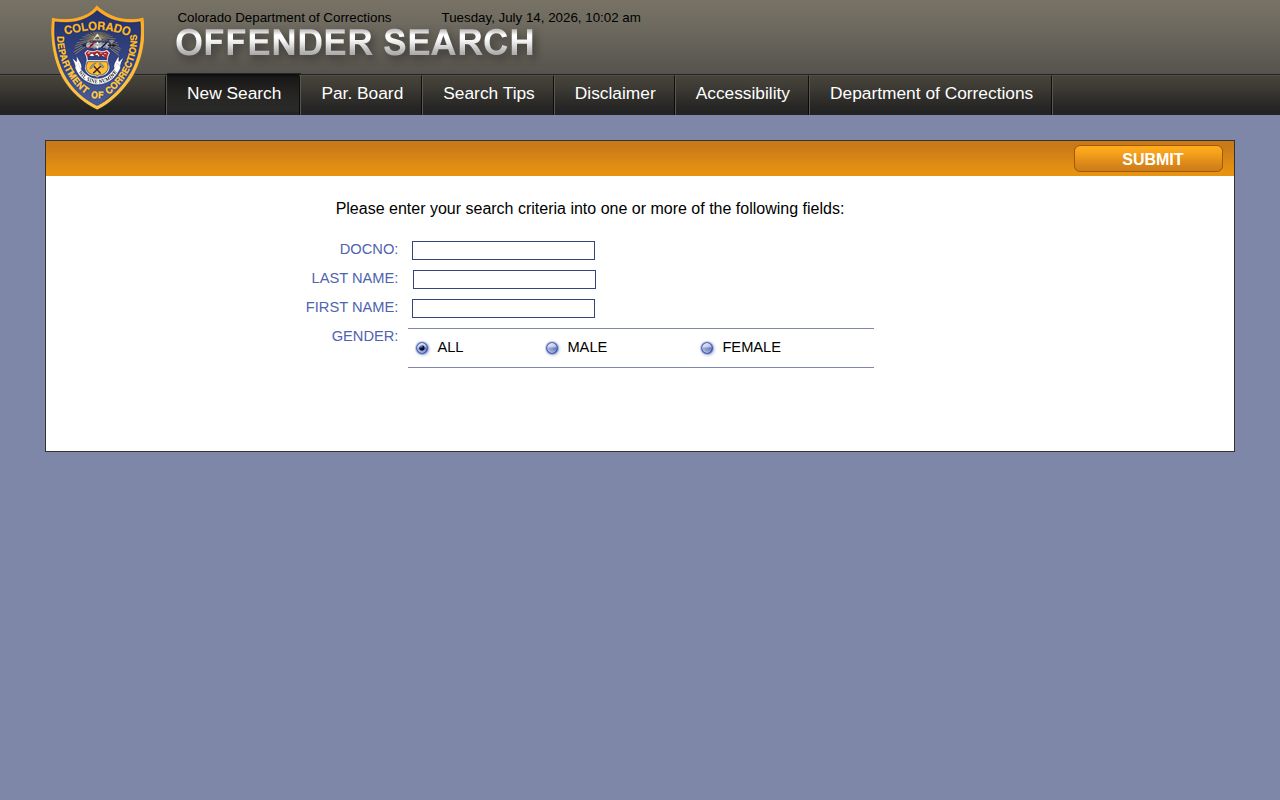
Those fields should not be used as the first source for short local jail custody, but they are central once the Cheyenne County case has become a CDOC prison or parole matter.
If the search returns several name matches, use the DOCNO, known court details, age information where shown, and sentence context to narrow the match. Do not treat a similar name as the right person. If the CDOC search returns no result, the person may have only a local Cheyenne County case, may be in a contracted jail before transfer, may be in federal or immigration custody, or may have a record that is not public through that state tool.
Colorado Release Date Rules
Colorado release-date computation is statutory and case-specific. C.R.S. 17-22.5-403 governs parole eligibility. The research notes a general parole-eligibility framework for many cases, plus higher thresholds for listed violent offenses based on offense date and case history. For certain crimes of violence committed on or after January 1, 2025, post-Proposition 128 rules require eighty-five percent service before parole eligibility and restrict reductions before that threshold.
C.R.S. 17-22.5-405 governs earned time and earned release time. It allows earned-time deductions within statutory limits for progress in work, training, programs, group living, counseling, and other criteria. The practical point for Cheyenne County users is that Colorado should not be reduced to one simple rule. Offense class, offense date, presentence credit, parole-board action, mandatory release law, and earned-time eligibility can all affect the projected date.
- Parole eligibility
- The point when a state prisoner may be considered for parole under Colorado law.
- Mandatory release
- A statutory state-prison release point that may still lead to parole supervision.
- Earned time
- Credit that may reduce state custody time when the statute and CDOC rules allow it.
- Mittimus
- The court sentencing document that directs a custody agency to carry out a sentence.
Cheyenne County Date Differences
Research Section 14 flags the main release-date quirk for Cheyenne County: local jail release timing and state-prison release timing answer different questions. A contracted jail can confirm when a person left jail custody. CDOC can confirm state-prison status, parole, or discharge. If a person is moved from a contracted jail to CDOC after sentencing, that is a county custody release by transfer, not a release into the community.
A local jail date can be affected by bond processing, a new hold, court scheduling, transport, time-served credit, or the policy of the actual jail that housed the person. A state date can be affected by presentence confinement credit, earned time, parole-board decisions, statutory thresholds, and later recalculation. Treat these as separate records. Pair the jail record with the court record, then use CDOC only if the sentence entered state custody.
Cheyenne County's contracted-custody model also means there may be more than one useful timestamp. The sheriff record can show arrest or transport. The housing jail can show booking and release. The court can show the order that allowed release or transfer. CDOC can show later state-prison parole or discharge timing. When dates conflict, ask which agency took the action on that date rather than assuming one source is wrong.
Note: A Cheyenne County contracted jail release date may be final for jail custody while a CDOC or parole record remains active.
Why Release Dates Change
A projected release date can move because the authority behind the date changes. The court may correct a sentence. CDOC may recalculate credit. A parole-board decision may grant release, defer it, or revoke it. Another agency may lodge a detainer or warrant. In Cheyenne County cases, the first question is whether the change belongs to the court, the contracted jail, CDOC, or another custody system.
| Change factor | How it affects the date | Where to verify |
|---|---|---|
| Court order or mittimus correction | Can change sentence terms or custody authority. | Cheyenne County court record |
| Presentence confinement credit | Can affect time already credited toward sentence. | Court sentence and jail record |
| Earned time gained or lost | Can move CDOC dates where the statute allows. | CDOC record |
| Parole decision or revocation | Can release, defer, or return a person to custody. | CDOC and State Board of Parole |
| Detainer, hold, or warrant | Can stop community release even when one sentence ends. | Holding agency, court, or jail |
| Transfer to another system | May end one custody record without ending custody overall. | Releasing and receiving agencies |
Confirm Cheyenne County Release
Confirmation should come from the agency that owns the date. For a contracted jail release, ask the sheriff which jail held the person, then ask that jail for the release date, release reason, and whether any hold or transfer followed. For a court date, request the case disposition or Register of Action from the Cheyenne County court. For a CDOC projected date, use CDOC and the parole-board route, then confirm if the public record is unclear.
Colorado VINE can help when the person is still in participating custody and a user needs notice of release or transfer. It is not a complete archive of old release records, and a no-match result is not proof that custody never happened. The notification workflow is covered on the Cheyenne County VINELink Check page. Use VINE as a status and alert tool, then verify the actual release record with the jail, court, or CDOC.
Keep transfer language precise. A person moved from a contracted jail to CDOC has left the jail, but that person has not necessarily been released from custody. A person released from CDOC to parole has left prison, but supervision may continue. A person discharged from sentence control has a different status again. The projected release date lookup should preserve those distinctions because each one points to a different record custodian.